Configuring Telemetry
Vehicle telemetry allows you to collect and transmit data about a vehicle’s performance and operation, so that it can be remotely monitored and analyzed.
Under Services > Telemetry, you can configure the AirLink OS Telemetry settings as shown below:
 Initializing Table Of Contents...
General
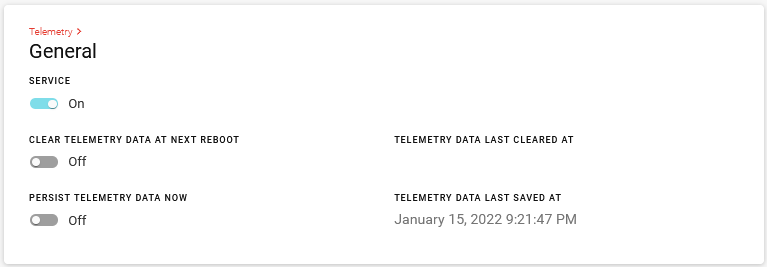
The following settings can be configured for AirLink OS Telemetry.
| SETTING | DESCRIPTION | OPTIONS | DEFAULT |
|---|---|---|---|
| SERVICE | Configure telemetry service to be enabled or disabled | On/Off | Off |
| CLEAR TELEMETRY DATA AT NEXT REBOOT | Erases all telemetry data at next reboot | Off/Pending | Off |
| PERSIST TELEMETRY DATA NOW | Saves telemetry data to flash storage. This is also automatically done at shutdown | Off/Pending | Off |
| TELEMETRY DATA LAST CLEARED AT | Shows the date and time that all telemetry data was last cleared. Read only. | N/A | N/A |
| TELEMETRY DATA LAST SAVED AT | Shows the date and time that all telemetry data was last saved. Read only. | N/A | N/A |
Vehicle Settings

Vehicle settings are a subset of telemetry. If vehicle ignition status reporting is desired, then the following settings must be set to specify how the router has been installed in the vehicle.
| SETTING | DESCRIPTION | OPTIONS | DEFAULT |
|---|---|---|---|
| DATA COLLECTION | Enables or disables data collection | On/Off | On |
| MODE OF OPERATION | Configures when data collection will be active |
|
Active always (Ignition status ignored) |
| VEHICLE IGNITION WIRING | This setting determines which input line the router monitors for ignition status. Select the option that matches how the vehicle ignition line has been connected to the router. |
|
Not connected to AirLink gateway |
| VEHICLE IGNITION STATUS | Current vehicle ignition status. Read only. | On/Off | N/A |
Vehicle Odometer
Odometer is not a standard OBD-II data point. On heavy duty vehicles and some selected light duty vehicles, it can be read from the CAN bus. However when it is not available, it can be derived from speed and distance traveled. Setting the derived odometer configures the starting point from which to calculate further distance.

| SETTING | DESCRIPTION | RANGE | DEFAULT |
|---|---|---|---|
| SET DERIVED ODOMETER (KM) | Sets the derived odometer with a starting value from which to calculate further distance from. | 0 to 1000000 | 0 |
| ENTERED AT | Date and time that the SET DERIVED ODOMETER was updated. Read only. | N/A | N/A |
| CURRENT ODOMETER (KM) | Current physical odometer reading. Read only. | N/A | N/A |
| CURRENT ODOMETER TIMESTAMP | Date and time that the CURRENT ODOMETER was read. Read only. | N/A | N/A |
AMR Reports

The complete telemetry data set can be sent to AirVantage allowing for the viewing of all Advanced Mobility Reports(AMR).
| SETTING | DESCRIPTION | OPTIONS | DEFAULT |
|---|---|---|---|
| ENABLE | When enabled, the full telemetry data set is sent to AirVantage so that all Advanced Mobility Reports(AMR) can be viewed. Only displays when Telemetry is enabled. | On/Off | On |
Custom Reports
Custom reports allow you to tailor your reports to better suit your needs. Initially you would define the report with specific data content and then you would assign it to the trigger event.
REPORTS
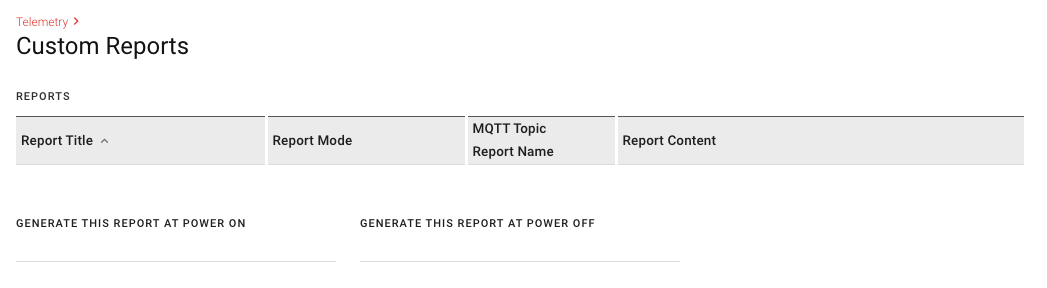
Define reports with your specific data requirements that can be sent to ALMS and/or an MQTT broker.
| SETTING | DESCRIPTION |
|---|---|
| REPORT TITLE | Name of the report used to reference this report in the trigger definitions section. Report Title is not sent as part of the report. |
| REPORT MODE |
Destination of where reports will be sent to. The MQTT configuration will only display if the REPORT MODE is set to an MQTT option. Options are:
|
| MQTT TOPIC REPORT NAME | Name of the report that will be included in the MQTT TOPIC. |
| REPORT CONTENT | List of all telemetry data points that will be used to generate a report. It is possible to select more than one of these data points for each report. |
| GENERATE THIS REPORT AT POWER ON |
Report that will be generated when the device powers on. Note: Only one report can be selected. |
| GENERATE THIS REPORT AT POWER OFF |
Report that will be generated when the device powers off. Note: Only one report can be selected and in situations where there is an abrupt power disconnect a report may not be generated. |
PERIODIC TRIGGERS (Generate reports at fixed intervals)
Reports can be generated at fixed time intervals using Periodic Triggers.

| SETTING | DESCRIPTION |
|---|---|
| ENABLE | When enabled, the configured report will be generated at each configured interval. Default is On. Options are On/Off. |
| GENERATE THIS REPORT… | List of reports that have been defined. Only one report can be selected. |
| EVERY… (SECONDS) | Number of seconds between each report interval |
UNCONDITIONAL TRIGGERS (Generate reports upon every data sample)
Reports can be generated when a data sample changes using Unconditional Triggers.

| SETTING | DESCRIPTION |
|---|---|
| ENABLE | When enabled, the configured report will be generated at each data sample. Default is On. Options are On/Off. |
| GENERATE THIS REPORT… | List of reports that have been defined. Only one report can be selected. |
| AT EVERY SAMPLE OF… |
When the data item sampled has changed from the last sample, the configured report will be generated. Options are:
|
Example 1: GPIO Input Cumulative
GPIO Input Cumulative is calculated using the Primary GPIO Input (line 4 of the power connector). Any change in the GPIO Input will affect the GPIO Input Cumulative and generate a report.
Example 2: WAN Ready
A WAN Ready sample is generated when WAN connectivity of the router switches between up or down.
Example 3: Ignition Status
- Time A: Ignition is DOWN.
- Time B: Ignition is UP.
- Time C: Ignition is DOWN.
Two Ignition Status samples are generated because the Ignition Status changed.
Example 4: Primary WAN
A PRIMARY WAN sample is generated whenever there is a switch in which interface is evaluated as primary.
- Time A: Wi-Fi Client is UP and is designated as the PRIMARY WAN. Cellular is also UP.
- Time B: Wi-Fi Client is UP. Cellular is DOWN.
No PRIMARY WAN sample is generated in this example.
- Time A: Wi-Fi Client is UP and is designated as the PRIMARY WAN. Cellular is also UP.
- Time B: Wi-Fi Client goes down. The PRIMARY WAN designation is re-evaluated to see if Wi-Fi Client is still the PRIMARY WAN, and it is not. Wi-Fi Client – Down. Cellular – New PRIMARY WAN.
A PRIMARY WAN sample is generated in this example.
DELTA TRIGGERS (Generate reports at minimum change in value or maximum elapsed time)
Reports can be generated using Delta Triggers when the sampled value has changed at least the configured amount since the last sample or a configured maximum time has passed.

| SETTING | DESCRIPTION |
|---|---|
| ENABLE | When enabled, the configured report will be generated when the sampled value has changed at least the configured amount since the last sample or a configured maximum time has passed. Default is On. Options are On/Off. |
| GENERATE THIS REPORT… | List of reports that have been defined. Only one report can be selected. |
| WHEN THIS ITEM’S SAMPLED VALUES… |
Options are:
|
| CHANGE BY THIS AMOUNT SINCE LAST REPORT… | Range from 0 to 1000000 |
| OR THIS TIME ELAPSES SINCE LAST REPORT (OPTIONAL - SECONDS)… | Range from 1 to 3000000 |
LEVEL TRIGGERS (Generate a report for each monitored data sample that meets the trigger condition)
Reports can be generated when a configured condition is true.

| SETTING | DESCRIPTION |
|---|---|
| ENABLE | When enabled, the configured report will be generated when the configured condition is true. Default is On. Options are On/Off. |
| GENERATE THIS REPORT… | List of reports that have been defined. Only one report can be selected. |
| WHILE THIS ITEM’S SAMPLED VALUES ARE… |
Options are:
|
| <RELATIONAL OPERATOR> |
Options are:
|
| THIS THRESHOLD VALUE | Range from -1000000 to 1000000 |
Example: LEVEL Trigger

If you define a LEVEL trigger that reports vehicle speed when vehicle speed >= 55 KPH, then each sample at and above the red line would generate a report. These samples represent the moments when the configured level threshold for vehicle speed was true. (i.e. Samples C, D, E, F, G, H, L, M are all >= 55 KPH).
EDGE TRIGGERS (Generate one report when monitored condition becomes true)
A single report can be generated when a monitored condition crosses the configured edge threshold.

| SETTING | DESCRIPTION |
|---|---|
| ENABLE | When enabled, the configured report will be generated when the configured condition is true. Default is On. Options are On/Off. |
| GENERATE THIS REPORT… | List of reports that have been defined. Only one report can be selected. |
| WHEN THIS ITEM’S SAMPLED VALUES BECOMES |
Options are:
|
| <RELATIONAL OPERATOR> |
Options are:
|
| THIS THRESHOLD VALUE | Range from -1000000 to 1000000 |
Example : EDGE Trigger

If you define an EDGE trigger to generate a report when vehicle speed >= 55 KPH, then samples C and L would each generate a report. These samples represent the moments when the configured EDGE threshold for vehicle speed was true. (i.e. Sample B is < 55 KPH and Sample C is >= 55 KPH; Sample K is < 55 KPH and Sample L is >= 55 KPH).
MQTT
The MQTT section appears only when a custom report has the REPORT MODE set to an MQTT option.
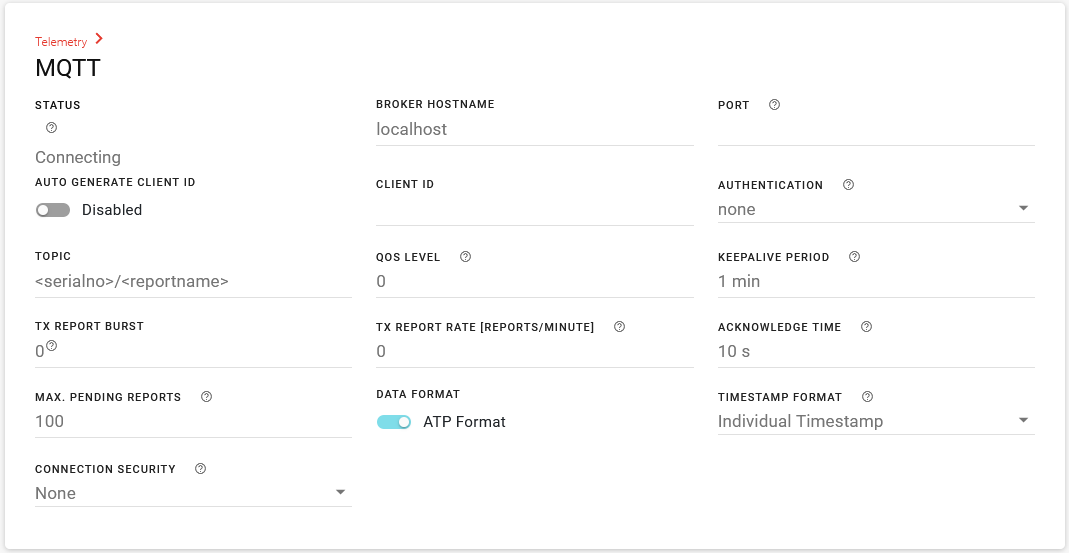
A destination MQTT broker can be configured using the following settings.
| SETTING | DESCRIPTION | OPTIONS | DEFAULT |
|---|---|---|---|
| BROKER HOSTNAME | Hostname of MQTT broker | IPV4 | localhost |
| PORT | Port that the MQTT broker is listening for incoming connections | Default port normally used is 1883. See your MQTT broker administrator. | N/A |
| AUTO GENERATE CLIENT ID | Enables the router’s serial number to be used as the client ID. Enable AUTO GENERATE CLIENT ID if your MQTT broker configuration rejects connections with an empty client ID. You can enable and add this setting to a template and apply it to your fleet instead of configuring a unique client ID for every router. | Enabled, Disabled | Disabled |
| CLIENT ID/ GENERATED CLIENT ID |
Enter a unique MQTT client ID for the router, if required by the MQTT broker. Leave blank for the MQTT broker to assign a client ID. When AUTO GENERATE CLIENT ID is enabled, the router serial number is displayed as the GENERATED CLIENT ID. |
N/A | N/A |
| AUTHENTICATION | Authentication information used to connect to MQTT broker |
|
None |
| TOPIC |
Used to identify the subject of a message.
6Q1099009902AC24/test {
  “atp.ser” :
   {
        “t”: 1693258321.3640001,
        “v” : “6Q1099009902AC24”
    },
        “ts” : 1693268920.464
}
|
<serialno>,<usbmac>,<ethernetmac>,<clientid>,<reportname>, or user defined. | <serialno>/<reportname> |
| QOS LEVEL | Quality of Service level |
|
0 |
| KEEPALIVE PERIOD | Maximum time that can elapse between two messages | 0 to 3600 s | 1 MIN |
| TX REPORT BURST | Maximum number of reports to send before rate limiting | 0 to 1000 | 0 |
| TX REPORT RATE [REPORTS/MINUTE] | Maximum number of reports to send per minute | 0 to 6000 | 0 |
| ACKNOWLEDGE TIME | Time to wait for acknowledgement | 1 to 600 s | 10 s |
| MAX PENDING REPORTS | Maximum number of pending reports before it will start to purge the oldest | 100 to 100000 | 100 |
| DATA FORMAT | Format of data sent to MQTT broker. |
|
ATP FORMAT |
| TIMESTAMP FORMAT | Format of timestamp used in report sent to MQTT broker. |
|
Individual Timestamp |
| CONNECTION SECURITY |
Sets how the security of the MQTT connection is handled. AirLink OS supports TLS encryption for MQTT traffic. |
|
None |
| ROOT CERTIFICATE |
When CONNECTION SECURITY is set to Use TLS with Custom CA, select or create a root certificate. For more information about certificates, see Managing Security Certificates. 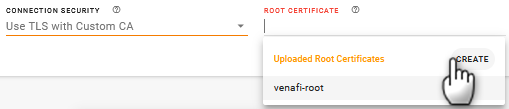
|
Any existing root certificate |
N/A |
More information about MQTT can be found here.