Logging
AirLink OS routers gather two types of logs: regular logs and audit logs. These log files can be accessed directly on the router when locally connected to it. When using ALMS, these log files are available by retrieving the logs from the ALMS dashboard of the router.
The AirLink logs do not contain any passwords.
All logging options are found under System > Logs.

 Initializing Table Of Contents...
Note: Neither factory resetting nor reflashing will erase the logs. There is no current method to erase either of the logs. A log rotation policy is used to control the size of the logs.
Direct Connection Logs
When directly connected via LAN connection to the AirLink router, the choices that appear are as follows:
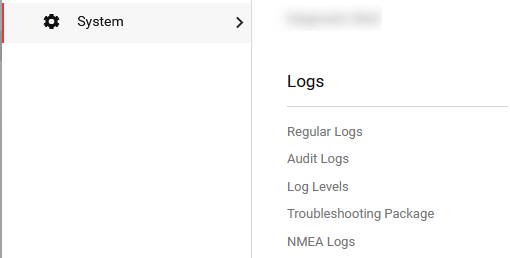
- Regular Logs display the device log files, making it easier to identify the root cause of any issues or errors.
- Audit Logs contain all the device changes since date of manufacture.
- Log Levels control how detailed the regular logs will be. Audit logs are not affected by log level changes.
- For information on the Troubleshooting Package, refer to Troubleshooting Package .
- NMEA Logs allow you to download a compressed NMEA log file from the router for location-related troubleshooting.
When selecting either Regular Logs or Audit Logs, the log file will appear.
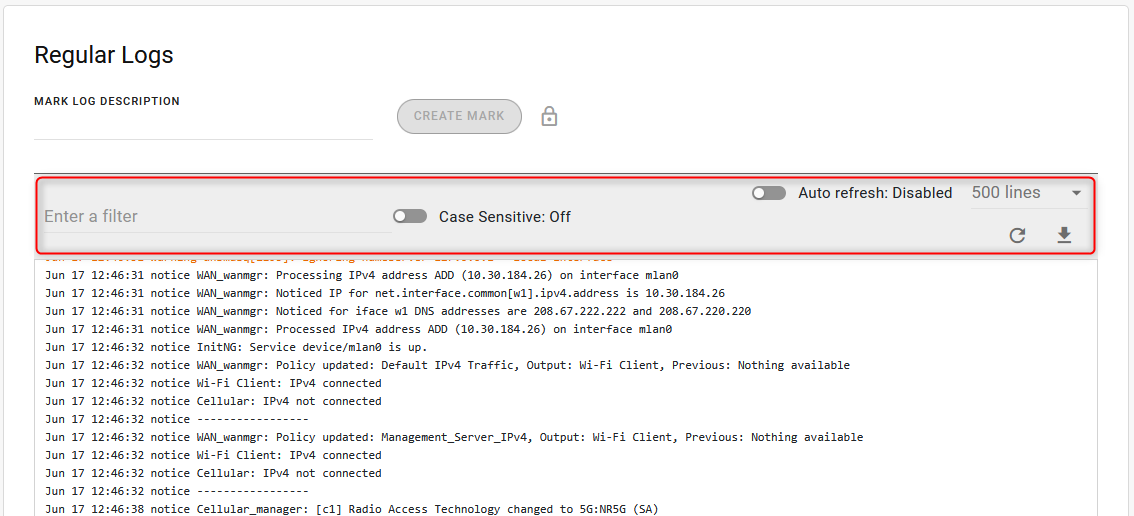
Using a filter helps narrow down the search for a specific event. Case sensitivity is set to off by default. Auto refresh is also disabled by default, and the display is limited to 500 lines unless the limit is changed.
To refresh the view with the latest events, click  .
.
To download each log file to your local PC, click  .
.
Marking Logs
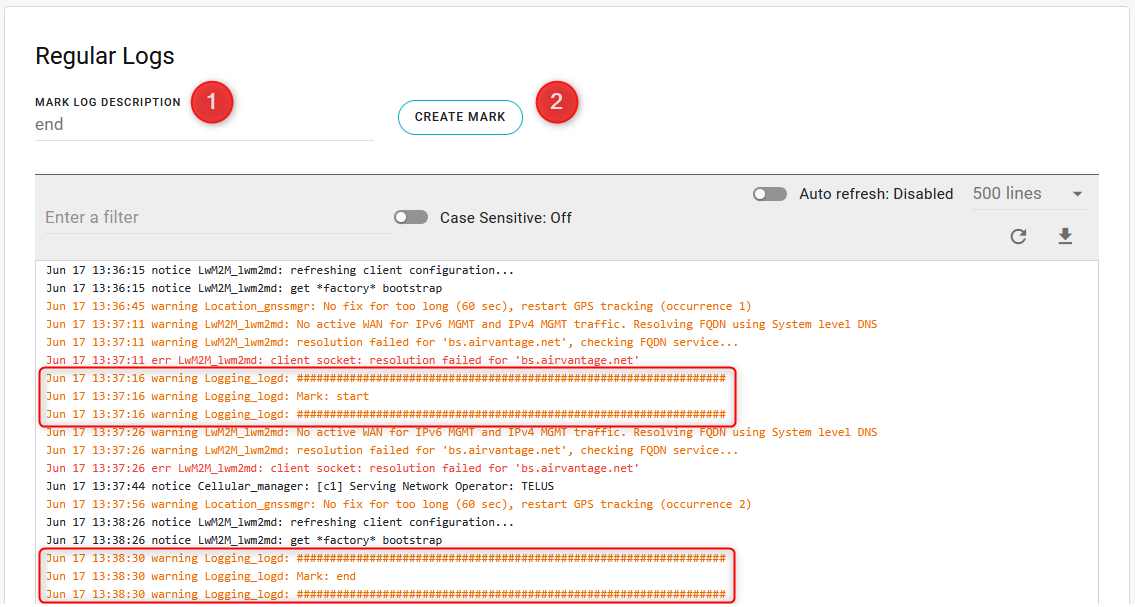
You can “mark” the regular log with a customizable message to identify locations of interest in the stream of log messages. For example, you can use this feature to mark the start and end points of a device test.
To find marks in a downloaded log file, do a text search for Mark: and/or the MARK LOG DESCRIPTION.
To mark a log file:
- Enter the MARK LOG DESCRIPTION, which will appear in the log file.
- Click CREATE MARK when you want to add the mark to the log.
A new mark will appear at the bottom of the log message window. Click
You cannot use the same MARK LOG DESCRIPTION twice in a row.
Filtering Logs
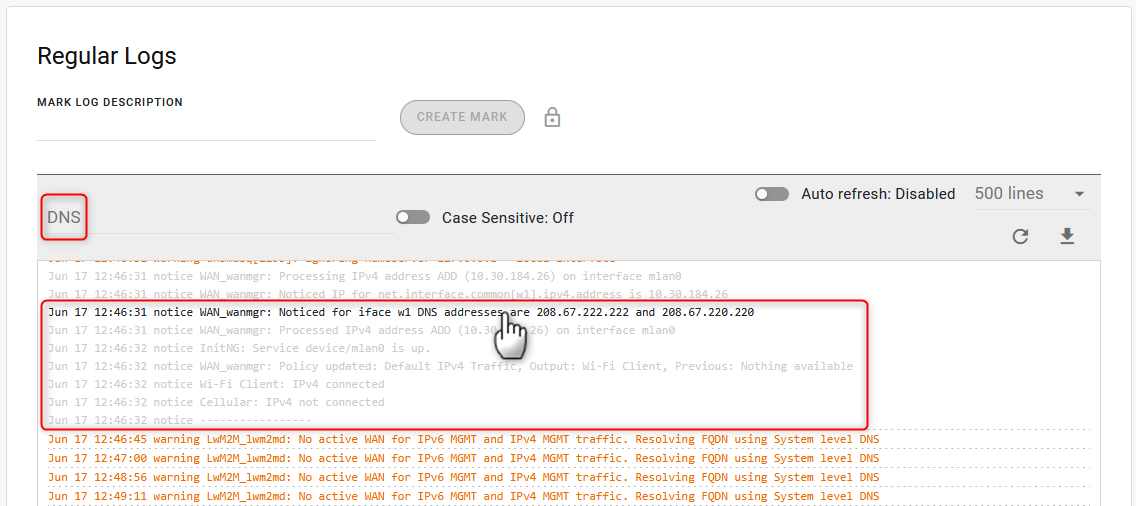
When filtering the display for a specific event, such as DNS, only lines with the word DNS will appear. To view events that occurred around a specific DNS event, click that line to expand and display events from the same time period. Those lines not containing the filtered word will be dimmed. There is no impact on what is stored in the regular logs.
ALMS Logs
When viewing the router’s AirLink OS configuration in ALMS, only Log Levels appears as a configuration option in the Logs menu. However, other logging options are available in ALMS, as described below.

To retrieve the router’s logs in ALMS:
- In ALMS, go to Monitor > Systems.
- Select the router to view the router’s ALMS dashboard.
- Under More, go to Retrieve and click the desired option.
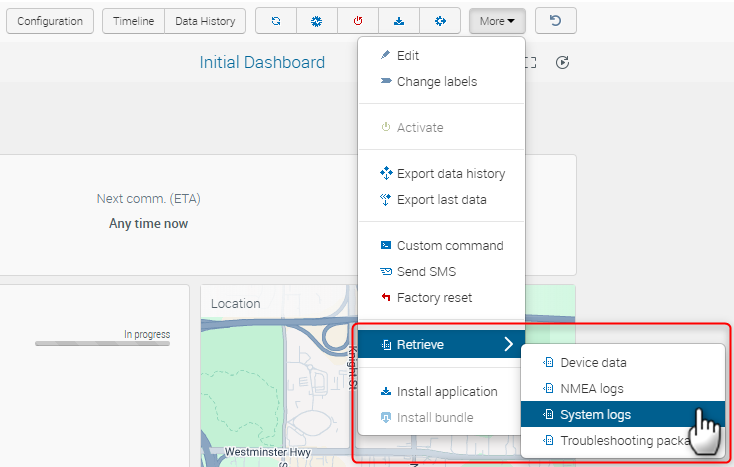
- Device data: Select a dataset to retrieve the corresponding data
- NMEA logs
- System logs
- Troubleshooting package
Log Levels
There are a number of different log levels, each indicating the level of severity of the message. You can configure Log levels on individual systems within AirLink OS. Below is an example showing a few of the systems with their log levels.

- EMERGENCY: System may be unusable
- ALERT: Action may need to be taken immediately
- CRITICAL: Critical condition of device
- ERROR: Error conditions are detected; AOS may attempt to recover with or without a reboot
- WARNING: A significant, but unusual event has occurred that may require corrective action on the part of AirLink OS or the end user
- NOTICE: (default): Normal, but significant events have occurred
- INFO: Information regarding events that have occurred
- DEBUG: Detailed information that may be useful during an extensive debug process
WARNING: It is recommended that all the settings be kept at NOTICE, unless directed by Semtech Technical Support. INFO and DEBUG should only be used under guidance from the Semtech support team, as the messages that they produce are intended for developer-level troubleshooting.
NMEA Logs
NMEA Logs allows you to download a compressed NMEA log file from the router for location-related troubleshooting.
As part of the troubleshooting process, you may be asked to download NMEA sentences before sending them to Semtech or your distributor. If asked to do so, first enable NMEA logging under Services > Location > General and then click NMEA LOGS to download a compressed log file.
